
Trauma & Orthopaedics
Specialty Champions
2024-2025: Alex Carton & Devanshu Gupta
2025-2026: Rory Harman & Sanmi Odiase
What does a career in T&O entail?
A trauma and orthopaedic surgeon (T&O) will manage both acute injuries and chronic conditions relating to the musculoskeletal system including bones, joints, ligaments, tendons, muscles and nerves.
Why practice T&O?
No day is ever the same with a blend of acute trauma cases and elective surgeries offering a dynamic working environment
Helping people of all backgrounds from a hip replacement that allows a pensioner to walk without pain to repairing an ACL tear in a young athlete
You also provide a massive and immediate improvement in their quality of life
This is a very hands-on specialty. If you’re a DIY pro who knows their way around a drill, you’ll love your time in theatre, but clinics still allow for plenty of patient facing care
As well as getting stuck in with your hands, T&O is at the forefront of innovation with techniques such as robotic assisted surgery, minimally invasive arthroscopy and 3D printed custom implants
Private practice opportunities are not hard to come by in T&O supplementing your income around 1.4x your NHS salary
Things to consider about a career in T&O
Any surgical job comes with its long hours including on call and weekend shifts
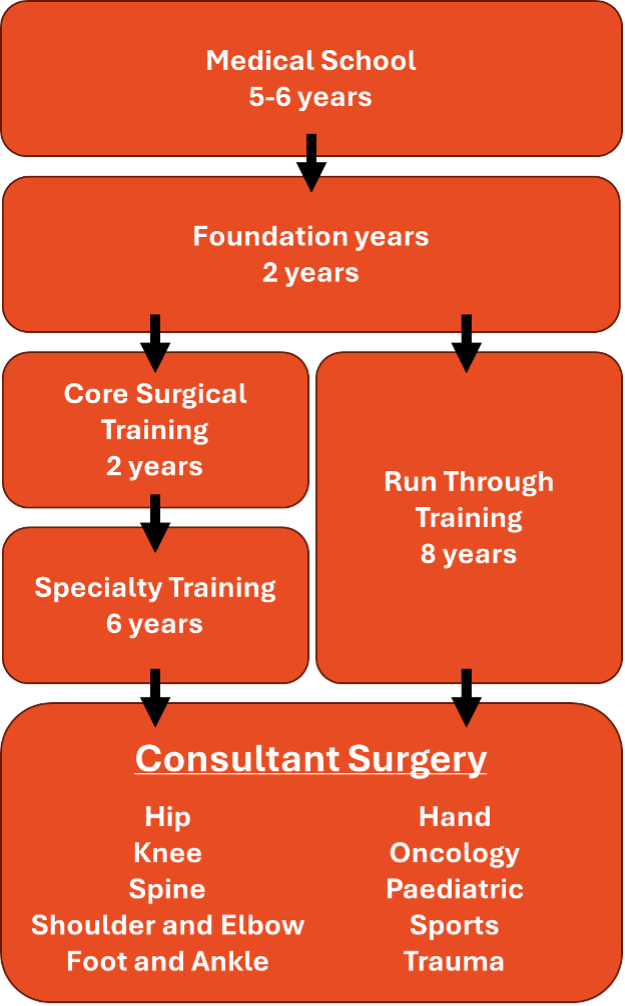
The training pathway is long, starting from ten years post-graduation to reach
These operations can be pretty physically intense, I know I have felt exhausted after theatre and I’m just the medical student!
You can also go on to specialise in one of the wide range of subspecialties, tailoring your career to your interests. For example, specialising in a specific part of the body is possible like the spine or in a specific field like sports injury or complex trauma surgery.
Research opportunities are abundant with joint replacement techniques and biological repair allowing you to get involved in developing the treatments of the future.
What is the training pathway for T&O?
After your 2-year foundation programme you can pick between 2 pathways:
Core Surgical Training Vs Run Through Speciality training
Core surgical training allows you to sample the breadth of surgery and then specialise at the end of CT1 and 2. This does mean having to apply for an ST3 post which can be pretty competitive.
Run through training allows you to start specialty training right away (ST1-8) meaning you don’t have to compete at the ST3 level.
No matter the pathway you choose, after your second year (CT2/ST2) you must pass the MRCS exam to become a member of the Royal College of Surgeons. Then during your specialty training you can go on to discover your subspecialty interest before your completion of training (FRCS exam).
What academic and professional resources are available for T&O?
There are loads of resources out there that can help supplement your musculoskeletal and T&O knowledge. Aside from the obvious TeachMe or MCQ websites you can also have a look at:
Orthobullets: It’s a bit American so don’t take every recommendation as gospel, but it is a great resource for cases, questions and even podcasts that are all free for you to use. It covers everything from the patient presentation and pre-op planning to operative techniques and recovery.
Radiopaedia: The go-to resource for imaging across all specialties but especially for X-rays and CT scans with overview pages on multiple T&O conditions.
Orthoclips: A library of lectures on orthopaedic presentations and procedures all for free.
Journal of Orthopaedic Trauma: Available through Queen’s institutional access. You don’t have to read every article or even most but knowing some of the areas of research can be helpful if you’re considering any research e.g. an2 SSC or just trying to impress a consultant.
Youtube – Nabil Ebraheim: A great library of videos on conditions, surgical techniques and reviews of relevant anatomy to T&O.
Royal Society of Medicine: The RSM website has an orthopaedics section with podcasts from surgeons talking about their experiences and different T&O presentations.
Also here are some accounts from orthopaedic surgeons showing their day to day and highlighting relevant clinical cases.
What can you do as a medical student interested in the specialty?
Show commitment to the specialty!
At this early stage don’t act like you’re married to T&O but definitely don’t just keep it casual. Specific electives or SSCs can help you to show dedication but if you’re struggling to achieve this, I recommend finding an orthopaedic surgeon and showing interest in the specialty. Most of them love to show off so will be happy to take you along to one or two operations where you can start your surgical logbook and at least find out more about if this specialty is for you. The operating theatre is the best way to pick up the lingo and what the day-to-day life actually looks like.
Relevant clubs like Scrubs or the Orthopaedics Society are useful to gain better exposure into the specialty. Also, any conferences or any teaching you’re aware of can be helpful (*cough* Scrubs Orthopaedic Webinar *cough cough*) but don’t spend an arm and a leg on what’s going to be a footnote on your resume. Do what you’re interested in and sample everything medicine has to offer but nothing is absolutely necessary.
Signposting events and opportunities relevant to T&O
British Orthopaedic Medical Students & Foundation Doctors Association (BOMFA)
A national organisation with regional committees including Northern Ireland, who often run events in collaboration with Scrubs.
British Orthopaedic Association:
Medical student prize – submission of written work of orthopaedic interest (see the most recent 2024 prize for the type of work asked for) with prizes for both the winner and certificates for other exceptional submissions.
BOA annual congress allowing submission of abstracts and for you to take part in loads of relevant workshops (available on MedAll if you don’t want to fly over).
Membership shows commitment to the specialty, but this is ~£20 annually so I would only consider it in the later years of medical school (Y4/5) but this does provide free registration to the annual congress
British Orthopaedic Trainee Association
A medical student elective prize can help to fund electives in T&O and is linked to the BOA.
Royal Society of Medicine
The Royal Society of Medicine has an Orthopaedics section with multiple upcoming conferences and symposiums.
MedAll
MedAll has many events and teaching sessions from all over the world with a personal favourite of EoEOrtho but just search “orthopaedics” and see what’s available with a certificate for your portfolio.
Scrubs events
Events like “Behind the Scalpel” allow you to meet and network with T&O surgeons which can help you gain opportunities like getting in to theatres.
General surgical skills workshops will arm you with skills you can use across all of your placements.