
Otorhinolaryngology (ENT)
Specialty Champions
2024-2025: Ryan McKenna & Sheya Chan
2025-2026: Rachel Megarry & Alannah Canavan
Introduction to ENT
Otorhinolaryngology, or Ear, Nose and Throat (ENT) surgery, is a uniquely broad specialty that combines medical and surgical expertise. The specialty is often described as ‘cradle to grave’, caring for patients of all ages across a wide spectrum of disease. For medical students, ENT provides valuable skills relevant to almost every branch of medicine, from managing acute airway emergencies to recognising hearing loss and balance disorders. Despite this, undergraduate exposure is often limited, meaning electives and taster weeks can be crucial in sparking interest and providing insight into the diverse opportunities within the field.
Sub-specialities include:
Head and Neck Surgery
Otology
Skull Base Surgery/Neuro-Otology
Thyroid and Parathyroid Surgery
Rhinology
Facial Plastic Surgery
Paediatrics
Laryngology
Procedures in ENT
ENT is a technically diverse specialty that makes use of microscopic, endoscopic, and open surgical techniques depending on the pathology.
Common procedures include tonsillectomy, adenoidectomy, grommet insertion, septoplasty, endoscopic sinus surgery, mastoidectomy, thyroidectomy, parotidectomy, and cochlear implantation.
Microscopic surgery is particularly valuable in otology, where the fine structures of the ear demand precision. Endoscopic approaches are widely used in rhinology and laryngology, offering excellent visualisation and minimally invasive access to the sinonasal passages and larynx.
Open surgery remains essential for head and neck procedures such as thyroidectomy, neck dissections, and major oncological resections, where wide exposure is required.
The breadth of surgical approaches reflects the variety within ENT and ensures that trainees develop a wide range of operative skills.
Why ENT?
Pros
VARIETY! Diverse patient population, conditions, and mix of medical and surgical interventions
The idea that ENT carries an excellent work–life balance remains true in many areas of the UK, with on-calls from home starting at registrar level
Opportunities to subspecialise (e.g. otology, rhinology, head and neck, paediatrics, facial plastics) or remain a generalist
High levels of patient satisfaction, with many interventions offering immediate improvements (e.g. restoring hearing, relieving airway obstruction)
Technological innovation (microscopy, endoscopy, robotics, implants) keeps the specialty at the forefront of surgical development
Cons
Highly competitive specialty with limited training posts
Steep learning curve for fine surgical skills, especially microsurgery
Limited undergraduate exposure
Much of ENT focuses on improving quality of life (e.g. hearing, sinus, voice disorders) rather than life-saving interventions, which may not appeal to those primarily motivated by acute, high-stakes surgery
Service provision often stretched due to high demand (e.g. long waiting lists for common operations like tonsillectomy or sinus surgery)
Training Pathway
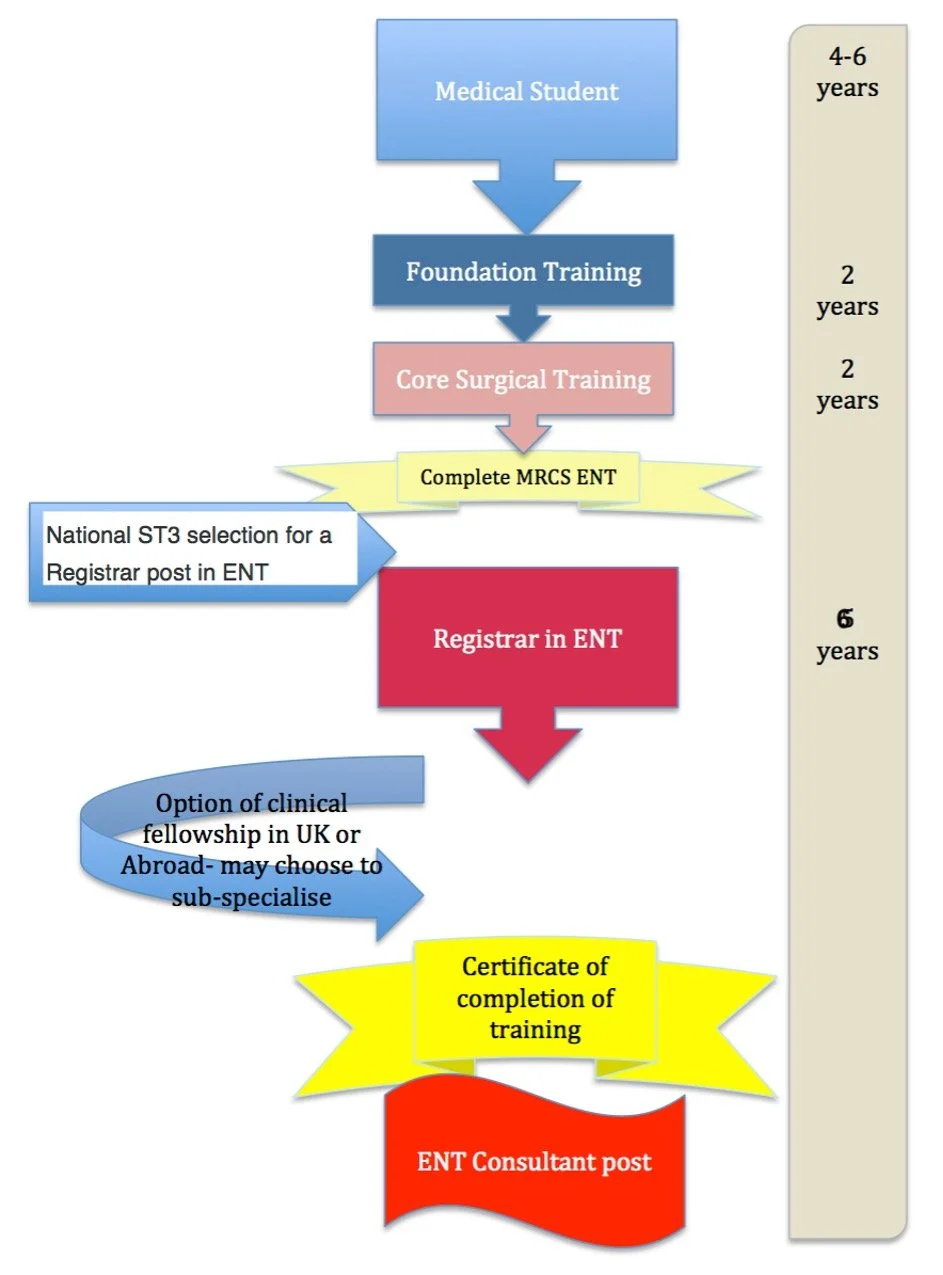
Both Core Surgical Training and ENT ST3 recruitment is handled regionally in Northern Ireland, most recent competition ratios are:
CST: 22.49
ENT ST3: 9.5
MRCS ENT (DOHNS) has been discontinued in favour of MRCS Part B
Learning Resources
Essential
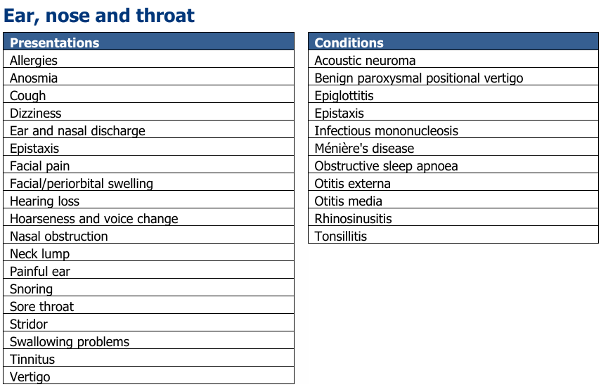
MLA Content Map - Key Presentations and Conditions:
The MLA content map is a structured guide that outlines the core knowledge that UK medical students are expected to achieve during undergraduate training. This outlines the essential ENT learning material for medical students
ENT UK Undergraduate Handbook:
A concise and reliable guide produced by ENT UK, covering key ENT conditions, examinations, and management principles. It’s an excellent starting point for medical students preparing for exams or clinical placement
Further Learning
ENTSHO.com
An online resource primarily designed for ENT trainees, offering clear and concise guidance on common ENT presentations and emergency management. While aimed at trainees, it’s also an excellent resource for students seeking a deeper understanding of ENT beyond the undergraduate level.
AOT Podcast
Primarily aimed at postgraduate ENT trainees preparing for higher exams, this podcast is also highly valuable for medical students, offering clear insights into how to approach OSCE scenarios and clinical discussions in a structured, examiner-focused way
Textbook: Scott-Brown’s Otorhinolaryngology, Head and Neck Surgery
Often referred to as the Bible of ENT. It is a comprehensive three-volume reference text that covers the full spectrum of otolaryngology and head and neck surgery. It is widely regarded as the definitive resource for clinical practice and first principles in the specialty.
Other Textbooks:
Dhingra’s Diseases of Ear, Nose and Throat & Head and Neck Surgery
K.J. Lee’s Essential Otolaryngology
Cummings Otolaryngology: Head and Neck Surgery
Relevant Professional Organisations
The Royal College of Surgeons governs this speciality. ENT UK is the professional body for Otorhinolaryngology in the UK. It contains Membership and Special Interest Groups spanning all of the key sub-specialities and levels of training e.g. BRS - The British Rhinological Society, BSO – The British Society of Otology, WENTS UK – Women in ENT Surgery UK.
Student and Trainee Groups:
ENTUK SFO – The Students and Foundation Doctors in Otolaryngology Group aims to raise awareness of ENT careers and provide opportunities for early career development
AOT – Association of Otolaryngologists in Training
NENTSS – National ENT Student Societies Collaboration
QUB ENT Society – QUB’s undergraduate ENT society dedicated to providing students with educational, academic, and practical opportunities in the field of ENT surgery
INTEGRATE - ENT research collaborative focused on promoting multi-centre research and academic collaboration among ENT trainees



Academic ENT Literature
General ENT journals:
JAMA Otolaryngology–Head & Neck Surgery
Laryngoscope
Otolaryngology–Head and Neck Surgery
Clinical Otolaryngology
European Archives of Oto-Rhino-Laryngology
Subspecialty-focused journals:
Otology:
Ear and Hearing
Journal of Otology
Otology and Neurotology
Journal of Vestibular Research
Rhinology:
Rhinology
American Journal of Rhinology and Allergy
Allergy and Rhinology
Head and Neck
Head & Neck
And more…
International Journal of Pediatric Otorhinolaryngology
Facial Plastic Surgery
Journal of Laryngology & Otology
ENT ST3 training allocates points based on Impact Factor of the journal published in, for a full list of valid journals and their impact factor, visit here.
Current Hot Topics in ENT
Expansion of biologics in treatment of chronic rhinosinusitis
Biologics such as dupilumab are now established in managing severe, refractory CRSwNP, with trials of newer agents (e.g. benralizumab, mepolizumab, omalizumab) underway and real-world data influencing guideline updates.
De-escalation of HPV-positive head and neck cancer
Interest in reducing treatment toxicity for HPV+ oropharyngeal SCC has been tempered by interim results from NRG-HN005 showing standard chemoradiation outperformed de-escalated IMRT/biologic regimens, underscoring the need for caution.
Development of totally implantable cochlear implants and vestibular implants
Advances in fully implantable CIs are ongoing, aiming to eliminate external hardware, while vestibular implants remain in active development for patients with bilateral vestibulopathy
Opportunities related to ENT
Positions:
ENTUK SFO University Representative
QUB ENT Society
Scrubs Speciality Champion
Annual Meetings:
ENTUK SFO Conference
ENTUK Subspeciality Meetings e.g. BSO Juniors Conference
BACO International
RAMI ORL HNS Registrars Prize Meeting
Irish Otolaryngology Society
Irish Head and Neck Society Annual Meeting
Courses:
ENT Masterclass
AOT runs an annual course at ASIT conference
Competitions:
ENTUK SFO
Essay Prize
Elective Prize
Innovation Prize
ASIT X AOT
Poster Prize for best abstract at annual ASIT conference, sponsored by AOT
Keele University ENT Society
National Case Competition open to all UK medical students