
General Surgery
Specialty Champions
2024-2025: Aaliyah Qadir & Cara Pirie
2025-2026: Tulika Nahar & Vidya Kalidindi
An Introduction to General Surgery
General surgery is a versatile and dynamic specialty that focuses on the diagnosis, treatment and management of a broad range of conditions. It includes surgical care for the gastrointestinal tract, breast, and endocrine systems, as well as oncological surgery, transplantation, and general pediatric cases.
As one of the largest surgical specialties in the UK, general surgeons are vital in emergency departments, providing emergency surgical care when needed. They also play a key role in rural and remote areas, where their broad skill set is essential to address diverse patient needs when access to specialists may be limited.
General surgeons are often the first responders to emergencies like acute appendicitis, trauma, and bowel obstructions. In addition to handling these urgent cases, they perform elective procedures such as hernia repairs and gallbladder surgeries. The specialty demands a mix of technical skills, strong clinical reasoning, and adaptability to manage a wide variety of patients effectively.
What are some of the sub-specialties of General Surgery?
Upper and Lower Gastrointestinal Surgery
Colorectal Surgery
Hepatopancreatobiliary (HPB) Surgery
Trauma and Emergency Surgery
Transplant Surgery – Kidney, Liver and Pancreas
Endocrine Surgery
Breast Surgery
Vascular Surgery
What are some of the common conditions seen and procedures performed in General Surgery?
Common Conditions
Appendicitis
Acute cholecystitis
Hernias (Umbilical, inguinal, femoral)
Malignancy (e.g., Oesophageal, stomach, colorectal cancers)
Acute Pancreatitis
Diverticulitis
Common Procedures
Laparoscopic appendectomy
Cholecystectomy
Hernia repairs
Bowel resections
Endoscopic procedures (e.g., gastroscopy, colonoscopy)
Why General Surgery?
Benefits:
Wide variety of clinical presentations and surgical procedures
Opportunity to make an impact on patient outcomes
Availability of subspecialty pathways to suit diverse interests
Mix of elective and emergency cases
Drawbacks:
Competitive training pathway with intense workloads. In 2024, the competition ratios for surgical training were 5.25 for core surgical training (CT1) followed by 3.76 for general surgical training (ST3)
Physically and mentally demanding
On-call commitments can affect work-life balance
What is the training pathway?
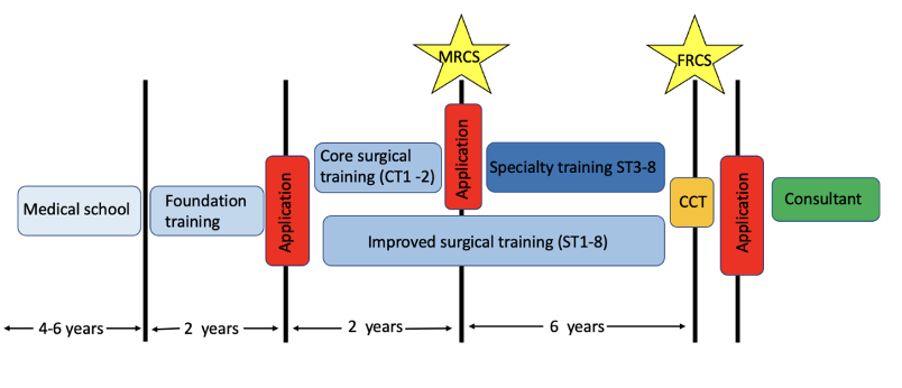
Like most surgical specialties, general surgery is generally NOT a run-through program. A run-through program for general surgery was piloted in England, Scotland and Wales, referred to as The Improving Surgical Training (IST). However, as of 2022, Health Education England has paused the IST pilot in England. The IST program continues to operate in Wales and Scotland, where run-through surgical training posts for general surgery are still available.
The CST pathway involves applicants first applying for core surgical training, then general surgical training once completed.
To apply for CST:
Applicants must meet the eligibility criteria - https://www.rcseng.ac.uk/careers-in-surgery/careers-support/what-is-surgery-like-as-a-career/entry-requirements-and-training/
Take the Multi-Specialty Recruitment Assessment (MSRA) which will be used to shortlist applicants for interview - https://medical.hee.nhs.uk/medical-training-recruitment/medical-specialty-training/multi-specialty-recruitment-assessment-msra/taking-the-msra/overview-of-the-msra
Complete a portfolio which will be assessed during interview - https://medical.hee.nhs.uk/medical-training-recruitment/medical-specialty-training/surgery/core-surgery/core-surgical-training-self-assessment-scoring-guidance-for-candidates
Core Surgical Training (CT1 – CT2)
Core training lasts for two years and provides broad exposure to different surgical specialties, allowing trainees to develop foundational surgical skills.
During this phase, trainees must pass the MRCS (Membership of the Royal College of Surgeons) exams
Specialty Training (ST3 – ST8)
Upon completing core training, trainees apply for specialty training posts in General Surgery.
Specialty training typically lasts six
Trainees must pass the FRCS (Fellowship of the Royal College of Surgeons) exams, a rigorous assessment of their readiness for independent practice
Consultancy and Fellowships
After completing specialty training and obtaining the FRCS, trainees can apply for consultant posts in General Surgery
Many general surgeons pursue additional training in areas of interest
Other Opportunities
SAS Grade Positions: Some surgeons may choose to work as Specialty and Associate Specialist (SAS) grade doctors instead of pursuing consultancy.
Locum Opportunities: Trainees may undertake locum posts within surgical specialties after CT2 or during training transitions.
Essential Learning
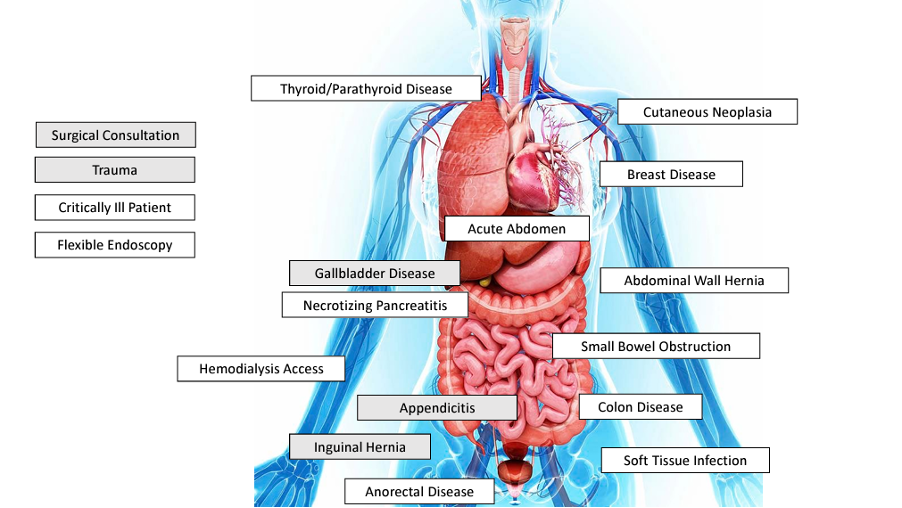
Key aspects of the MLA content map which relate to general surgery – there may be overlap with other surgical specialties
MLA Conditions
Acute cholangitis
Acute pancreatitis
Anal fissure
Aortic aneurysm
Appendicitis
Ascites
Biliary atresia
Breast abscess
Breast cancer
Breast cysts
Cholecystitis
Cirrhosis
Colorectal tumours
Fibroadenoma
Diverticular Disease
Gallstones and biliary colic
Gastric cancer
Gastrointestinal perforation
Gastro-oesophageal reflux disease
Hernias
Hiatus hernia
Hyposplenism/splenectomy
Inflammatory bowel disease
Intestinal ischaemia
Intestinal obstruction and ileus
Intussusception
Liver failure
Malabsorption
Mesenteric adenitis
Metastatic disease
Oesophageal cancer
Pancreatic cancer
Peptic ulcer disease and gastritis
Perianal abscess and fistulae
Pyloric stenosis
Surgical site infection
Volvulus
MLA Presentations
Abdominal distention
Abdominal mass
Acute abdominal pain
Acute and chronic pain management
Ascites
Bleeding from lower GI tract
Bleeding from upper GI tract
Breast lump
Breast tenderness/pain
Change in bowel habit
Change in stool colour
Chronic abdominal pain
Constipation
Decreased appetite
Diarrhoea
Fatigue
Fever
Jaundice
Lump in groin
Massive haemorrhage
Melaena
Nausea
Perianal symptoms
Post-surgical care and complications
Pruritus
Rectal prolapse
Swallowing problems
Trauma
Vomiting
Weight Loss
Possible OSCE Stations Related to General Surgery
Altered bowel habit history - Patient with a history of rectal bleeding
Thyroid history
Breast lump history
Abdominal examination
Breast examination
Thyroid examination
Hernia examination
Abdominal X-ray - Interpretation, diagnosis and management
Suturing
Recommended resources for students relevant to General Surgery
Textbooks:
Essential Surgery: problems, diagnosis and management
McLeod’s Clinical Examination
Moore’s Clinical Anatomy
Websites:
Zero to Finals
Teach Me Surgery
Geeky Medics
OSCE Stop
BMJ Best Practice
Relevant Professional Organisations and Academic Literature
Relevant Organisations
Royal College of Surgeons of England/Edinburgh/Ireland
Association of Surgeons in Training (ASiT)
Surgical Specialty Associations – e.g., Association of Upper GI Surgeons (AUGIS)
Journals
British Journal of Surgery (BJS)
Journal of the American College of Surgeons (JACS)
The Lancet
https://www.rcseng.ac.uk/library-and-publications/library/guide-to-services/online-journals/
Examples of Literature
Heywood, N. et al. (2021) The laparoscopy in emergency general surgery (LEGS) study: A questionnaire survey of UK practice, Annals of the Royal College of Surgeons of England.
Morris, M.X. et al. (2024) Current and future applications of Artificial Intelligence in surgery: Implications for clinical practice and research, Frontiers in surgery.
Please, H. et al. (2024) Virtual Reality Technology for Surgical Learning: Qualitative outcomes of the first virtual reality training course for emergency and essential surgery delivered by a UK–uganda partnership, BMJ Open Quality.
Signposting for Opportunities Relevant to General Surgery
Conferences
SCRUBS Surgical Conference
ASiT
Association of Surgeons of Great Britain and Ireland Annual Congress
Other general surgery conferences can be found at: https://www.yorksandhumberdeanery.nhs.uk/surgery/general_surgery/trainee_area/courses_and_conferences
Competitions
ASiT – ‘Medical Student Prize session’
Annual Association of Surgeons of Great Britain and Ireland Annual Congress Undergraduate Essay Prize Competition
National Intercollegiate Surgical Skills Competition
QUB Final Year Prizes
Sinclair Medal
O'Connell Prize
Grants and Funding
Magrath Clinical Scholarships
Relevant QUB SSCs
Year 3
Neuroendocrine tumours
POCUS (Point of Care Ultrasound)
Relevant Intercalation Opportunities
MSc Clinical Anatomy – QUB, University of Edinburgh, University of Birmingham, Hull York Medical School
MSc Laparoscopic Surgery and Surgical Skills - Barts and The London School of Medicine and Dentistry
Elective Opportunities
General surgery electives are available for application in NI – relevant application forms/details are available on individual trust websites
It is also possible to plan a general surgery elective abroad
For countries like Australia, Canada and the United States, electives are available through other universities or may be possible to plan through a contact
Electives can also be planned via. Organisations with a focus on surgery – However, it may not always be possible to solely focus on general surgery, some electives may include 2 or more surgical specialties
Past Summer Studentships
The Patrick G Johnston Centre for Cancer Research (PGJCCR) have previously offered studentships in Gastro-intestinal cancers
Wellcome-Wolfson Institute for Experimental Medicine:
Identifying the mechanisms of Gremlin1 signalling in colorectal cancer
Centre for Public Health
Using early Health Technology Assessment to assess the potential value of an innovative diagnostic test for pancreatic cancer