Plastic Surgery
Specialty Champions
2024-2025: Christopher Archer & Carlo Ferrazzano
2025-2026: Christopher Archer & Gan Qi Sen
What is Plastic Surgery?
Plastic surgery is a specialty that involves the repair, reconstruction, or alteration of the human body. It aims to improve both function and appearance, addressing physical deformities, defects, or aesthetic concerns. The term "plastic" in plastic surgery derives from the Greek word plastikos, meaning "to mold or shape," and does not refer to synthetic materials.
What are the pros & cons of Plastic Surgery?
Pros:
Diverse Procedures: Offers variety, from reconstructive to cosmetic surgeries.
Life-Changing Impact: Improves patients' physical function, appearance, and confidence.
High Earning Potential: Among the highest-paid specialties, with growing demand.
Innovative Field: Advances in technology and techniques keep the work exciting.
Flexibility: Options for private practice, specialization, and autonomy.
Creative Fulfillment: Combines technical precision with artistry.
Recognition: Highly respected specialty with appreciative patients.
Team Collaboration: Engages with multiple disciplines like oncology and dermatology.
Cons
High Training Requirements: Long and costly education and training process, including need for relocation due to low training numbers.
Demanding Work: Long hours and high-pressure environments.
Unrealistic Expectations: Patients may have unattainable goals.
Ethical Concerns: Issues related to body image and over-treatment.
Physical Strain: Risk of burnout and long-term strain on hands and body.
Public Perception: Stigma around vanity or superficiality.
What are some of the common conditions seen & operations performed in Plastic Surgery?
1. Congenital Deformities
Cleft Lip and Palate
Polydactyly
Haemangiomas
2. Trauma and Wounds
Burns
Fractures requiring reconstruction
Lacerations and skin injuries
3. Breast Conditions
Breast Reconstruction after mastectomy
Gynecomastia
4. Hand and Reconstructive Surgery
Carpal Tunnel Syndrome
Dupuytren’s Contracture
Trigger finger
5. Skin Conditions
Melanoma
Moles and skin lesions
6. Aging and Cosmetic Concerns
Facelifts
Rhinoplasty
Liposuction
Abdominoplasty
Breast Augmentation/Reduction
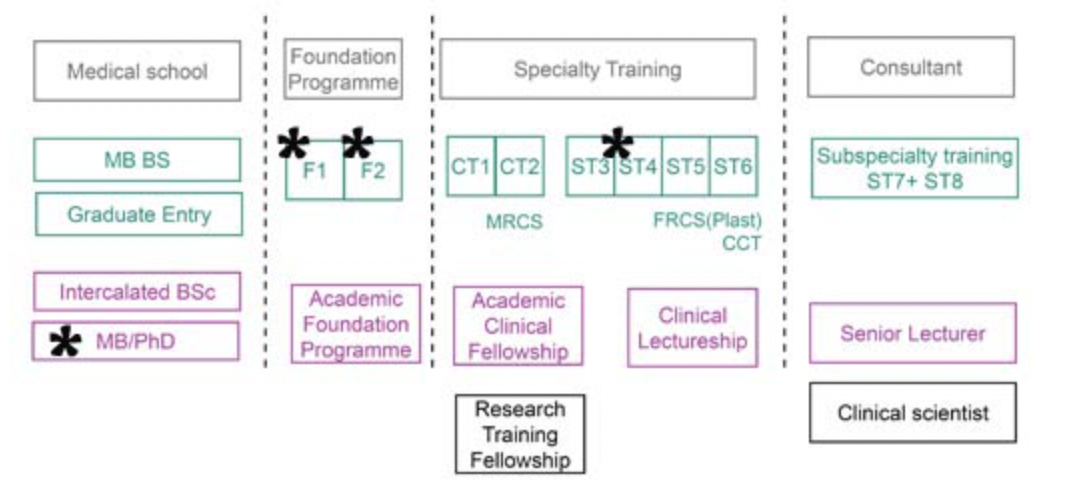
What is the training pathway for Plastic Surgery?
How to get involved
Taster Events & Training Courses
At the medical student level, it is difficult to gain exposure of plastic surgery through events or courses as they are predominantly aimed at the foundation doctor and core surgical trainee levels. However, students can still boost their CV by attending surgical events and training courses such as those outlined below:
Kingsbridge Foundation Course in Surgical Skills – a full day course aimed for medical students of all years interested in surgery (as well as FY1 doctors), covering various hand tying and suturing techniques, excision of skin on animal tissue, removal of a sebaceous cyst while using drainage & use of a laparoscopic simulator. Typically held in Autumn with prices around £135.
RCSEng Surgical Skills for Students & Health Professionals – one day course held in London, UK focusing on suturing techniques & knot tying. Prices start from £180.
NIFTSS (NI Foundation Trainees Surgical Society) – hosts regular sessions on MedAll delivered by a range of doctors, surgical trainees & consultants. Their Teaching Webinar series covers topics such as the MRCS exams, core surgical training interviews, various specialty training pathways, taking a surgical F3 Year and so on.
NIFTSS Surgical Skills Day/Course – this in-person event held at the Ulster Hospital provides insightful talks, hands-on surgical workshops & networking opportunities.
Plastic Surgery Societies
BAPRAS - £25 annual subscription, membership allows for a discounted rate to attend events, meetings & courses, such as , also gives free access to the Journal of Plastic, Reconstructive & Aesthetic Surgery. Also host an Undergraduate Day which provides insightful talks into what a career in plastic surgery entails and how to prepare for the application process in addition to facilitating multiple surgical skills workshops.
PLASTA UK – free membership, work in conjunction with BAPRAS, run multiple webinar and journal club sessions, have also held various workshops in the past at the Association of Surgeons in Training Annual Congress. Also offer a limited number of grants to medical students to facilitate attendance at events and conferences.
PRASSA – a Uk student-led plastic surgery association which organises educational events and seek to improve awareness of plastic surgery amongst medical students. Some of their key initiatives include a National Webinar Teaching series and an inaugural 2024 UK National Conference.
QUB societies, events & opportunities
Clinical Placements – while plastic surgery remains relatively untouched in the current medical curriculum at QUB, there are still opportunities for medical students to gain practical experience in plastic surgery through relevant student selected components and during their clinical years i.e., 3rd-5th year. While on clinical placement, students should be aware of the plastic surgery related services offered across the Trusts. These include:
Ulster Hospital – Plastics Trauma Clinic on Level 2 Critical Care Block, Hand Therapy Department in 1st Floor of Ulster Hospital and the Regional Plastic and Oral Maxillofacial Unit on Ward 4C in the Inpatient Ward & Ward 8 Day of Surgery Admissions Unit.
Royal Victoria Hospital – Norman C. Hughes Regional Burn Unit on Ward 2E
Antrim Area Hospital – Breast Unit in Level A.
Altnagelvin Hospital –Specialist Services Ward on Ward 5; treatment of minor and major head and neck injuries by both Oral & Maxillofacial and ENT services.
Scrubs – QUB’s official surgical society which hosts a multitude of relevant events, such as:
Surgical Skills Day which provides the opportunity for students to participate in varying surgical workshops – including a plastic surgery workshop in which students can practice procedures such as tendon repairs and skin lesion resections.
Suturing Events are also held throughout the academic year from beginner to advanced levels. Suturing is an essential skill that all aspiring surgeons should become proficient in, especially for those interested in plastics considering the aesthetic and these events
For the past few years, Scrubs have also held a very popular Behind the Scalpel event where students are able to meet with surgeons from various specialties, including ENT, orthopaedics, plastic surgery etc. This is a very good opportunity for students to network with surgeons and gain insight into their prospective specialty.
QUB PRASS – a society aimed at increasing awareness and knowledge of plastic surgery by holding a variety of lectures, workshops & seminars. Also provides information on the pathways into plastic surgery and advice on building a competitive CV.
Clinical Anatomy Society – hosts regular teaching events via MedAll with a focus on high yield anatomical concepts and their clinical relevance. These sessions are beneficial for all those interested in a career in surgery.
Intercalated degrees
These are BSc or MSc degrees which medical & dental students may undertake either abroad or within QUB between Years 3-4 or 4-5 and provide students the opportunity to explore an area of particular interest. With respect to plastic surgery, the MSc course in Clinical Anatomy is particularly relevant as it develops a greater understanding of advanced human anatomy including appropriate radiological anatomy, microscopic anatomy and embryology.
Students also receive training in research methods and enhance transferable skills such as researching literature and critical scientific thinking. Additionally, most universities allow students to propose a research project of their own if they have an area of particular interest; students interested in plastic surgery could propose projects related to tendon/nerve repairs or transfers, skin grafts, skin cancer resection/excision and so on. During the completion of such research projects students can network with experts in the relevant field and can also go on to present their work at conferences and publish it in journals.
Further information on the intercalated degrees offered at QUB is available at: https://www.qub.ac.uk/schools/mdbs/Study/IntercalatedDegrees/.
Conferences & competitions
ASiT Conference – often held over 3 days in March, this conference offers the opportunity for medical students to submit an abstract for an oral or poster presentation on a piece of surgery related research e.g., audits, case reports, systematic reviews etc. Additionally, a range of workshops are held over the duration of the conference, including core skills in plastic surgery, the mammary fold & PLASTA introduction to breast surgery course, laparoscopic skills course, introduction to surgical robotics, and many more.
RCSEd & Medtronic Surgical Skills Competition – a UK-wide competition open to medical students of all years. Students are required to complete an online quiz following which the top 5 scoring participants from each medical school will progress to the next round. The 2nd stage consists of 3 tasks – usually 3 suturing techniques – which students will perform using a skills kit sent to them from RCSEd. Students must video themselves completing these tasks and upload them for marking. The top scoring students will then reach the Grand Final, a one-day event held in Edinburgh. The RCSEd covers the cost of travel and accommodation for all students.
Surgical Research Society Annual Meeting – a 2-day conference often at the start of the calendar year which centres on the presentation of research undertaken by surgeons in training and medical students and can be in poster or oral format. The 2-day conference is usually preceded by a free training day which focuses on pursuing an academic career in surgery, critical appraisal of research, and so on, however spaces are limited to approx. 40 attendees. Students can apply to the Surgical Research Society for Young Investigator Awards of £300 to assist with travel & attendance costs.
Electives
At the end of 4th year, students have the opportunity to undertake a 6 week-long elective abroad &/or within the UK in a specific area of medicine or surgery and represents an ideal time for students to gain further exposure of plastic surgery.
Students may also opt to split their 6 weeks, with 4 weeks spent abroad and 2 weeks spent within the UK. This provides an additional experience of what their specialty is like within the NHS.
Plastic Surgery journal & literature
Journal of Plastic, Reconstructive & Aesthetic Surgery - https://www.jprasurg.com/
Aesthetic Surgery Journal - https://academic.oup.com/asj
Journal of Hand Surgery - https://www.jhandsurg.org/
Journal of Burn Care & Research - https://academic.oup.com/jbcr#google_vignette
Annals of Breast Surgery - https://abs.amegroups.org/
Journal of Dermatology & Plastic Surgery - https://www.remedypublications.com/journal-of-dermatology-and-plastic-surgery-home.php
British Journal of Surgery - https://academic.oup.com/bjs
Learning resources
The following are a series of links that will direct you to a variety of webinars & other educational resources for plastic surgery:
https://app.medall.org/c/united-kingdom-plastics-research-collaborative
https://www.plasta.org/education/resources/webinars_for_juniors.aspx
https://www.materplasticsurgery.com/webinars-and-educational-resources
https://www.uclahealth.org/medical-services/surgery/plastic-surgery/patient-resources/webinars