Neurosurgery
Specialty Champions
2024-2025: Glenn Calvert
2025-2026: Amaarah Udat & Vinay Murali Prasad
List of Contents
Learning Resources
Careers
Events and Opportunities
Learning Resources
Since the introduction of the C25 curriculum in 2020, most written examinations have been replaced with a “Progress Test” with sittings usually scheduled in November, February, and May. Each exam consists of 100 questions of various difficulties including Final MB level. Although neuroscience can be a challenging topic to master, many answers can be reasoned from first principles, provided that one possesses an understanding of the basics. For example, rather than committing the deficits of various spinal cord syndromes to memory, these are far easier to recall if one remembers the functional anatomy of the cord in cross-section.
So how should one go about studying this material? In the preclinical years, the course is heavily lecture-based. My approach was to attend the lectures, annotate the slides with notes (e.g., using Notability), then create flash cards using Anki.
For neuroanatomy, I strongly recommend the following resources:
Blumenfeld’s Neuroanatomy Through Clinical Cases (very clinical, great at illustrating why deficits emerge)
Neuroanatomy: An Illustrated Colour Text (small but detailed, fantastic images of gross anatomical specimens)
Clinical Neuroanatomy Made Ridiculously Simple (old but gold)
YouTube resources: The Noted Anatomist, Sam Webster, Brad Cole, Radiology Tutorials, Viva Voce of Anatomy
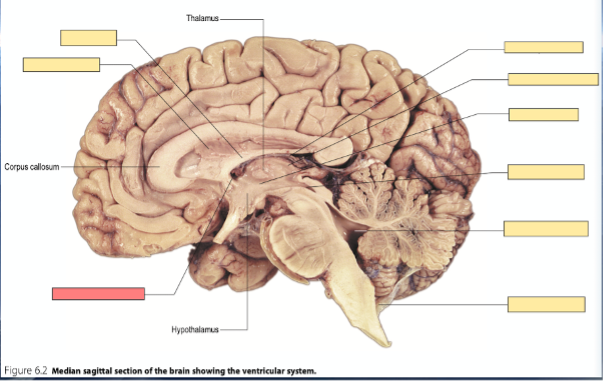
To help recognise anatomical structures, it is possible to download images online (e.g., from TeachMeAnatomy), or take screenshots of images in textbooks. These can then be imported into Anki using the Image Occlusion Tool. By occluding labels with shapes, one can generate a set of flashcards where the user is asked to identify a highlighted label (e.g., the red rectangle in the image below – it’s one of the interventricular foramina of Monro). This is a great resource for learning to identify structures, which is a staple of anatomy spotter exams.
For neurophysiology, I recommend the following resources:
Master Medicine Physiology (light on detail; a general purpose physiology text; written by a Queen’s academic – your physiology lectures will be based heavily on this text)
Neuroanatomy and Neuroscience At A Glance (small, concise; does what it says on the tin)
Some folks recommend Guyton and Hall’s Medical Physiology or Ganong’s Medical Physiology. Great if you’re a nerd, but more detail than you require at undergraduate level – at least at Queen’s
For pathology and pharmacology, I recommend concise, general-purpose textbooks, such as Pathology At A Glance and Medical Pharmacology At A Glance. I can count on one hand the number of times I have used Rang and Dale’s Pharmacology or Underwood’s Pathology.
In your clinical years, the emphasis switches unsurprisingly to clinical skills. The recommended resources are the usual culprits: GeekyMedics, OSCEstop, ZeroToFinals, and your question bank of choice. On YouTube, there are fantastic demonstrations of various neurological examination by Niall Tubridy on the UCD Medicine channel. For students with an interest in neurosurgery, there are two texts which may be of interest: Neurosurgery for Basic Surgical Trainees, and the Oxford Case Histories in Neurosurgery. These are beyond the undergraduate level but may be of interest to those wishing to explore the specialty in more depth.
Local Societies
QUB Scrubs
In previous years, we have arranged careers talks from local neurosurgeons (trainees and consultants alike), as well as practical skills workshops involving burr hole drilling, external ventricular drains, and intracranial pressure monitoring demonstrations
QUB NeuroSoc
In previous years, NeuroSoc have arranged mock OSCEs with a focus on neurosciences, as well as career talks and anatomy teaching sessions
QUB Radiology Society
Previously, RadSoc have arranged career talks from local neuroradiologists, including both diagnostic and interventional neuroradiology (neuroradiology, interventional neuroradiology)
External Societies and Prizes/Funding
Association of British Neurologists (annual undergraduate prize for clinical cases/audits/basic research)
NANSIG (probably the premier student interest group in neurosurgery, advertising many opportunities)
ASiT (annual conference with opportunities to participate in neurosurgery practical skills workshops, high acceptance rate for posters/oral presentations if you’re looking to develop your portfolio)
SBNS (undergraduate elective award to help fund your final year medical elective)
British Neuropathological Society (undergraduate bursaries to help fund medical electives)
British Society for Clinical Neurophysiology (annual medical student essay prize)
National Undergraduate Neuroanatomy Competition (annual neuroanatomy competition hosted by the University of Glasgow, preclinical and clinical categories, usually succeeded by an afternoon of talks and workshops)
Neurology – Career Pathway
In order to qualify as a neurologist, you must:
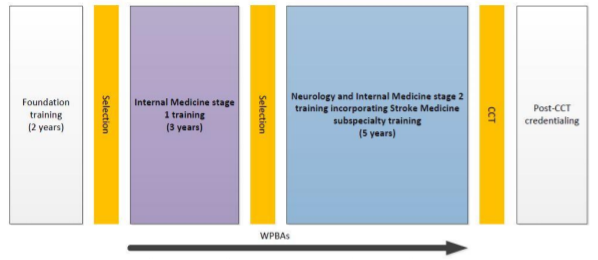
Complete 2 years of foundation training (FY1, FY2)
After competitive entry (portfolio, interview), complete 3 years of Internal Medicine Training (IMT1, IMT2, IMT3) as Neurology is currently a Group 1 Specialty (accurate as of 2025)
During this time, you should endeavour to complete Parts A and B of your Membership of the Royal College of Physicians (MRCP) exams – some choose to sit their Part A earlier (e.g., in FY2)
After competitive entry (portfolio, interview), complete 5 years of Higher Specialty Training (ST4, ST5, ST6, ST7, ST8)
This includes a minimum of 1 year in Internal Medicine and 1 year in Stroke Medicine
Upon completion of training, you will be awarded your Certificate of Completion of Training (CCT) in Neurology and Internal Medicine with a subspecialty in Stroke Medicine.
Note that you do not necessarily need to work across all three specialties as a Consultant
Neurosurgery – Career Pathway
In order to qualify as a neurosurgeon, you must:
Complete 2 years of foundation training (FY1, FY2)
After competitive entry (portfolio, MSRA, interview), complete 8 years of specialty training
The shortlisting matrix for the portfolio is listed on the Yorkshire and Humber deanery website. It varies little from one year to the next. It is rather vague in that specific details on how to maximise points in each domain are not provided.
If you are interested in neurosurgery, you should start working on your portfolio NOW – print out the matrix, pin it to the wall, speak with current trainees, and think carefully of how you are going to satisfy each domain. I am happy to be contacted if you have any questions.
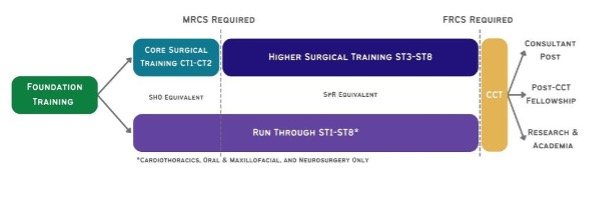
Unlike many surgical specialties, neurosurgery is largely a “run-through” programme, i.e., there is no need to complete Core Surgical Training beforehand
Trainees in their early years (ST1, ST2) generally rotate through allied specialties (e.g., neurology, neuropathology, neuro ICU, neuroradiology) but this is very much unit-dependent
You must pass Parts A and B of the Membership of the Royal College of Surgeons (MRCS) exam by the end of ST3 – it is not uncommon for keen, budding surgeons to sit their Part A during FY1!
Upon completion of training, you will be awarded your CCT in Neurosurgery. At this stage, many surgeons will complete various fellowships to develop their skills further in their area of interest.