
Cardiothoracic Surgery
Specialty Champions
2024-2025: Hannah Bibby & James Cartlidge
2025-2026: Bazil Shahzad & Tirth Shah
What is Cardiothoracic Surgery?
Cardiothoracic surgery is the specialty which involves performing operations on the heart, lungs and other organs within the chest cavity. Diseases in this area of the body include significant causes of morbidity and mortality such as ischaemic heart disease and lung cancer. Cardiothoracics involves the diagnosis and management of these conditions, as well as the performance of complex surgeries, monitoring of patients in ICU post-operatively, MDT involvement, and patient follow-up in clinic. The specialty also provides significant opportunities for sub-specialisation, research and teaching. It is a specialised field which is primarily found in larger, tertiary centres and as such can be particularly competitive.
What are the sub-specialties within Cardiothoracic Surgery?
Cardiothoracic surgeons will specialise into one of either cardiac (heart, aorta and other vasculature) or thoracic (lungs, chest wall and other thoracic organs) surgery specifically on progressing to the second phase of their training, typically around ST4 level. Within each of these branches, there is opportunity for further sub-specialisation based on specific areas of interest. During the final stage of training, national selection can be entered to allow for subspecialisation in the field of congenital cardiac surgery. Another significant area for subspecialisation is in cardiothoracic transplant surgery.
What are some of the common conditions and procedures performed in the specialty?
Cardiac
Ischaemic heart disease
Heart valve disease
Aorta vascular disease
Cardiac tumours
Cardiomyopathy
Thoracic
Lung malignancies
Chest wall deformities
Pleural disorders
Obstructive airways disease
Other major airways disease
Procedures
Cardiac
Coronary artery bypass graft
Valve repair / replacement
Aortic surgery
Ablation
Thoracic
Lung resection
Chest-wall deformity correction
Decortication
Thoracotomy
Video or robotic assisted thoracoscopic surgery
What are some of the pros and cons of the specialty?
Benefits
Your work will be hugely impactful on patients’ lives, there are numerous opportunities for sub-specialisation and career advancement, opportunities to use advanced and developing medical technology, lifelong learning and overall it’s just really interesting!!!
Drawbacks
The training pathway can be long and extremely competitive to get onto which could mean relocation, inevitably there will be long hours and maintaining a good work-life balance during training is tough. As with most surgical specialties, there will be emotional and physical demands due to the nature of the job.
What is the training pathway of the specialty?
Training is now typically completed as a run-through programme, beginning as a general cardiothoracic ST1 level trainee following foundations training. The image below outlines what the timeline usually looks like, though it is determined by completion of required competencies rather than a specific timeline.
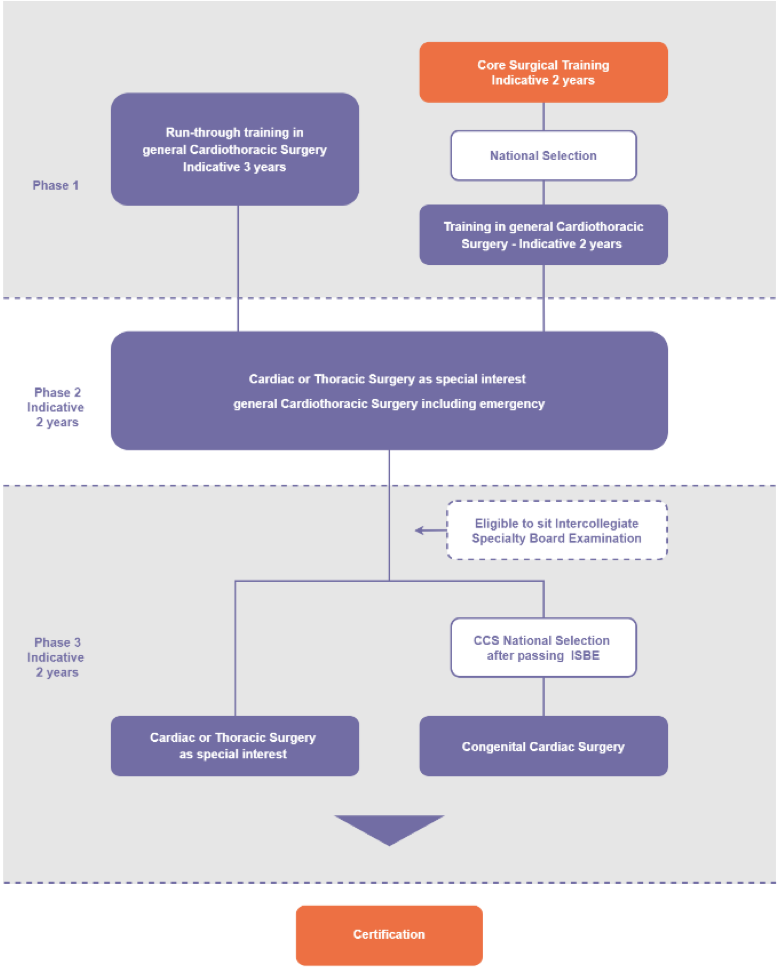
https://www.iscp.ac.uk/media/1108/cardiothoracic-surgery-curriculum-aug-2021-approved-oct-20.pdf
What examinations need to be completed for the specialty?
MRCS Part A (MCQ) and Part B (OSCE) – typically completed in foundation years.
Intercollegiate Specialty Board Examination (ISB) – SBA and clinical exam, taken after completion of phase 2 of training.
All trainees with have to cover a syllabus rating their level based on knowledge, clinical and technical skills in a wide range of areas in order to complete training and record process in their portfolio. Full details of this and the training pathway can be found at: https://www.iscp.ac.uk/media/1108/cardiothoracic-surgery-curriculum-aug-2021-approved-oct-20.pdf
What conditions / presentations pertaining to this specialty are covered by the MLA content map?
As this is quite a niche specialty, there is minimal requirement to know details of cardiothoracic surgery but lots of areas in the content map cover common conditions for which surgery may be required and general points surrounding the overall care of surgical patients. These include:
Lung cancer
Cardiorespiratory arrest
Cardiorespiratory failure
Post-surgical care and complications
Acute coronary syndromes
Valve diseases
Ischaemic heart disease
Aortic dissection
Stridor
Myocardial infarction
Pneumothorax
Many of these conditions are covered in QUB lectures given during the ‘blood, cardiovascular and respiratory systems’ module in year 1 which should be available on Canvas, with information regarding surgical care available from the year 3 portal.
What OSCE skills are covered by this specialty?
The most important relevant skills are definitely to make sure you have you full cardiovascular and respiratory history and examinations perfected. Additionally, stations may involve the assessment and management of acutely unwell patients, typically using the ABCDE method. In some cases, these patients with be suffering from cardiorespiratory emergencies, e.g acute coronary syndrome, asthma/COPD exacerbation.
What are some learning resources which cover the conditions seen and procedures performed by this specialty?
Some old videos about cardiac and thoracic surgery available on the year 5 area of the QUB med portal - https://www.med.qub.ac.uk/Portal/year5/surgicalcare_videos.aspx
Third-Party Learning Resources:
TeachMeAnatomy / TeachMeSurgery – for learning relevant anatomical structures and their physiology as well as core principles and procedures in the field (goes beyond necessary curriculum learning)
ZeroToFinals – notes and podcasts / videos relevant to many of the conditions included in the MLA content map
What professional organisations represent the specialty of Cardiothoracic Surgery?
The Society for Cardiothoracic Surgery
The representative body for cardiothoracic surgery in Great Britain and Ireland is the Society for Cardiothoracic Surgery (SCTS). The organisation was founded in 1934 and addresses the interests of patients, surgeons, allied professionals and students.
Their website (https://scts.org) hosts a wealth of helpful and interesting information, ranging from events to educational resources. They hold their Annual Meeting every March in different locations within the UK/Ireland.
There is a specific section dedicated within the website to medical students (https://scts.org/medical_students.aspx), showcasing mentorship initiatives, education events, useful resources and an electives repository.
They have set up a Student Education Committee ran by medical students, which caters events specifically towards students, with webinars and journal clubs. Keep up to date with them by following their Instagram: https://www.instagram.com/scts_studenteducation/
You can join the society for free as a medical student, sign up using this link: https://scts.org/join/default.aspx
The European Association for Cardio-Thoracic Surgery
The European Association for Cardio-Thoracic Surgery (EACTS) was founded in 1986. It is an organisation which supports the cardiothoracic community through education, cutting-edge learning opportunities, championing pioneering research through world-renowned journals and publications; with the ultimate aim of improving patient outcomes through best practices.
Their website (https://www.eacts.org) has lots of resources signposted, pertaining to education, publications, clinical practice guidelines and quality improvement. They host their annual meeting every October, in locations situated around Europe.
You can become a pre-trainee (medical student) member for just €20, click the following link to apply: https://www.eacts.org/our-community/become-a-member/
The Society of Thoracic Surgeons
This is the largest organisation dedicated to cardiothoracic surgery, founded in 1964. It is the professional body representing surgeons, researchers and allied healthcare professionals, who are dedicated to ensuring the best outcomes for heart, lung and oesophageal surgeries. It is based in the United States but has a global reach. It has lots of educational, research and registry analytic resources available. Their website is accessible through the following link: https://www.sts.org
What academic journals and literature are available concerning Cardiothoracic Surgery?
There are numerous journals with pertaining to the discipline of cardiothoracic surgery, the following are some of the main publications focussing solely on the specialty
The European Journal of Cardio-Thoracic Surgery: https://academic.oup.com/ejcts
The Journal of Thoracic and Cardiovascular Surgery: https://www.jtcvs.org
The Annals of Thoracic Surgery: https://www.annalsthoracicsurgery.org
Annals of Cardiothoracic Surgery: https://www.annalscts.com
Journal of Cardiothoracic Surgery: https://link.springer.com/journal/13019
Interdisciplinary CardioVascular and Thoracic Surgery: https://academic.oup.com/icvts
Some interesting studies which have been covered by the SCTS Student Education Committee, during their journal clubs include:
Initial Invasive or Conservative Strategy for Stable Coronary Disease: https://www.nejm.org/doi/full/10.1056/NEJMoa1915922
Percutaneous Coronary Intervention versus Coronary-Artery Bypass Grafting for Severe Coronary Artery Disease: https://www.nejm.org/doi/full/10.1056/NEJMoa0804626
Left Atrial Appendage Occlusion during Cardiac Surgery to Prevent Stroke: https://www.nejm.org/doi/full/10.1056/NEJMoa2101897
The ROMA trial: 7 years of trial activities and the development of the ROMA trial network: https://academic.oup.com/ejcts/article/65/5/ezae188/7675652
Segmentectomy versus lobectomy in small-sized peripheral non-small cell lung cancer: a multicentre, open-label, phase 3, randomised, controlled, non-inferiority trial: https://www.thelancet.com/journals/lancet/article/PIIS0140-6736(21)02333-3/abstract
SCTS has a list of randomised trials ongoing within the UK covering cardiac, thoracic and congenital surgery: https://scts.org/professionals/research/recently_published_trials.aspx
Other interesting resources concerning cardiothoracic surgery which you may wish to explore include:
CTSNet: https://www.ctsnet.org
The Multimedia Manual of Cardio-Thoracic Surgery: https://mmcts.org
British Thoracic Oncology Group: https://www.btog.org
What recruitment information is available concerning applying to the specialty?
Cardiothoracic Surgery is a nationally recruited, run-through specialty programme. All pertinent information relating to the application dates, document, matrix and post numbers may be on the NHS England Wessex Deanery Website: https://wessex.hee.nhs.uk/medical-dental-training-recruitment/core-and-specialty/cardiothoracic-surgery-st1-st4-national-recruitment/
What Cardiothoracic Surgery events take place during the year?
There are several annual events to keep a look out for, they include:
SCTS Annual Meeting: https://scts.org sts
EACTS Annual Meeting: https://www.eacts.org
ASiT Conference – ASiT x SCTS Core Skills in Cardiothoracic Surgery: https://asit.org
STS Annual Meeting: https://www.sts.org
BTOG Annual Conference: https://www.btog.org
QUB Scrubs Surgical Skills Conference – Cardiothoracic Surgery Workshop: https://www.instagram.com/qubscrubs/?hl=en
INSPIRE Conference hosted by QUB / UU
What QUB Student Selected Components may be relevant to the specialty?
QUB Student Selected Components, directly or indirectly related projects to cardiothoracic surgery:
Year 1
What’s to come for the Broken Hearted?
Tumour Immunology and Immunotherapeutics
Year 2
Cardiac Anaesthesia and Intensive Care
Challenges and Opportunities in Treating Secondary Cancer
Managing Univentricular Hearts
Year 3
Cardiology Imaging
Clinical Investigation of Cardiovascular Physiology
Intensive Care Medicine
Interstitial Lung Disease
Oncology: The Patient Journey
Radical Treatment of Early-Stage Lung Cancer
What intercalation opportunities are available that may give a better insight into the research element of the specialty?
You may wish undertake an intercalated degree in a programme related to cardiothoracic surgery, some of which include:
Cardiovascular Science iBSc (University College London)
Cardiovascular Medicine iBSC (King’s College London)
Cardiovascular Sciences BSc (Imperial College London)
Translational Cardiovascular Medicine MSc (University of Bristol)
Clinical Anatomy MSc (University of Edinburgh or Bristol)
Other resources / opportunities for students interested in the specialty
Royal College of Surgeons Edinburgh – Hospital Placements for Undergraduates – Cardiothoracic Immersion Programme for Medical Students: https://www.rcsed.ac.uk/career-hub/students/career-advice-for-medical-students/hospital-placement-opportunities-for-undergraduates
SCTS Electives Repository: https://scts.org/professionals/education/career_groups/medical_students/elective_repository.aspx