Oral & Maxillofacial Surgery
Specialty Champions
2024-2025: Fiona Guan & Medha Sridhar Rao
2025-2026: Medha Sridhar Rao & Tereska Sobocinska

What is OMFS?
Oral & Maxillofacial (OMF) surgeons specialise in the diagnosis and treatment of diseases affecting the mouth, jaws, face and neck.
It is a broad specialty which includes surgical and non-surgical management of conditions in patients of all ages, from newborns to the elderly.
Their work with children is usually concerned with congenital craniofacial deformities including cleft lip/palate. Young adults often require surgery following an injury or accident, whereas elderly people normally present with oral cancer or skin tumours of the face and head.
Many OMF surgeons focus on one of these areas to develop a sub-specialist interest within the scope of the wider specialty.
Oral and maxillofacial surgery procedures range from minor to major surgery, including:
Surgical treatment of complex facial injuries and soft tissue injuries of the mouth, face and neck
Removal of head and neck benign and malignant tumours
Reconstructive surgery, including microvascular free tissue transfer
Removal of impacted teeth and complex buried dental roots
Orthognathic surgery for the correction of facial disproportion
Pre-implant surgery, including the use of implants to retain facial or dental prostheses and associated bone grafting techniques as part of oro-facial reconstruction.
Removal of cysts and tumours of the jaws
Primary and secondary surgery for cleft lip and palate, and other congenital facial deformities.
Cosmetic surgery e.g. face lifts, rhinoplasty, eyelid and brow surgery
Temporomandibular joint surgery
Salivary gland surgery for benign and malignant lesions
Surgical treatment of congenital facial deformities
Removal of complex facial skin tumours and reconstruction
Due to the nature of the work, oral and maxillofacial surgeons often work alongside a variety of specialists in other fields such as ENT surgeons, clinical oncologists, plastic surgeons, orthodontists, restorative dentists, radiologists and neurosurgeons.
The training pathway for OMFS
Careers in OMFS | British Association of Oral and Maxillofacial Surgeons
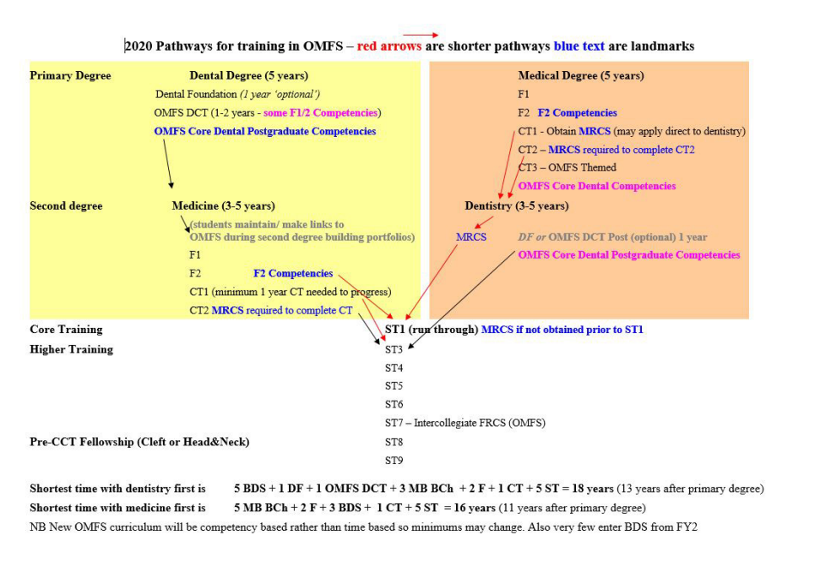
Both a medical and dental degree is required to specialise in OMFS. The training pathway differs depending on whether your first degree is Medicine or Dentistry.
For “medicine-first” trainees:
You will need to return to university and complete a second degree in dentistry; some universities offer a shortened 3-year BDS. You may choose to complete your 2-year core surgical training (CST) before pursuing your BDS. Alternatively, you can return to university after foundation training and prior to CST, in which case CST may be shortened to one year provided you have gained relevant competencies during this time; however, this route is not recommended as you may lack adequate exposure to surgery in general to make a reliable decision about your career.
Additionally, during or before CST, you must take the examination to obtain full Membership of the RCS (MRCS).
Following CST and MRCS, you need to apply for specialty training in OMFS, which lasts five years (ST3-ST7). At least six months of experience in OMFS prior to specialty training is desirable.
If you have an interest in academic work, you may pursue a research degree, eg an MD (2-3 years) or a PhD (3-4 years); however, this is not essential. By the end of specialty training, some trainees complete a 1-year Interface Training Fellowship in specialties which are open to or interface with other specialties (e.g. cleft lip/palate surgery, head and neck cancer).
In your last year, you will need to sit the Intercollegiate Specialty Examination FRCS (OMFS) in order to be eligible for the certificate of completion of training (CCT), after which you can go on to work as an OMFS consultant.
The available training pathways are summarised below:
Tips if you’re interested in a career in OMFS:
Try and shadow an OMFS senior or junior colleague to get an idea of what the career is like day-to-day.
Contact OMFS colleagues to see if you can involved with research, audits and QIPs taking place in the department
Join the university’s surgical society (QUB Scrubs) and attend conferences for an opportunity to explore the specialty and network with potential future colleagues.
Try to get a Student Selected Component in an OMFS-relevant topic (offered in Year 3 in QUB Medicine)
Consider joining associated institutes or professional bodies such as the British Association of Oral and Maxillofacial Surgeons (BAOMS); their Junior Trainees’ Group (JTG) provides support and information from current OMFS trainees.
During your foundation years, contact the OMFS department at your hospital and ask how you can get involved e.g. by organising an OMFS taster week
Attend courses offered by the Royal College of Surgeons.
Try to organise an elective in OMFS
QUB SSCs relevant to OMFS
QUB normally offers an SSC titled “The Face of Surgery: An Insight into Maxillo-Facial Surgery” in Year 3 of Medicine. This is a 3-week SSC based in Altnagelvin Hospital (Western Health and Social Care Trust) which aims to provide students with an opportunity to experience hands-on bedside teaching, theatres and clinics exploring all aspects of OMFS.
Intercalation opportunities
The University of Glasgow offers an intercalated course covering Otolaryngology (ENT)/Head and Neck Surgery: https://www.gla.ac.uk/coursecatalogue/course/?code=MED4057
Many intercalated courses, including Clinical Anatomy, offer the chance to pursue OMFS-related head and neck surgery topics as part of the course content with the opportunity to further explore the topic through an OMFS-based dissertation. Contact QUB’s anatomy department for more information.
Electives
Electives provide an opportunity to undertake an OMFS placement in Northern Ireland, ROI, GB and internationally.
QUB’s 5th year clinical elective normally takes place in July for 4-5 weeks during the summer between 4th year and 5th year. Starting planning your elective at the end of 3rd year and find out deadlines for submitting applications for different placements as some universities close elective applications early. The QUB Med Portal and the QUB Electives Team can provide more advice about electives.
The general requirements for electives include:
a letter of good standing from QUB
vaccination records
criminal convictions check like AccessNI
registration of your elective on the MDU or MPS website to cover the indemnity
BAOMs offer an elective bursary for students pursuing OMFS electives
NI and UK-based Electives:
Find out the points of contact for OMFS in NI: the 2 NI OMFS departments are based in the Ulster Hospital (South Eastern HSCT) and Altnagelvin Hospital (Western HSCT). Other trusts offer Head and Neck Surgery through an ENT route.
Most healthcare trusts in the UK, especially those affiliated to dental schools, offer OMFS services. Larger hospitals conduct OMFS theatres and have in-patient wards whereas smaller hospitals and DGHs offer day cases and out-patient services. Contact the hospital/dental school/medical school regarding OMFS elective placements and their requirements.
International Electives:
Shortlist hospitals that offer placements in OMFS and enquire if the placement is availble through an electives company if you are using it coordinate the elective
International electives will often require the documents stated above and they may also need other specialised documents including tuberculosis tests and transcripts. Contact the electives coordinator well in advance to understand and organise all the required documentation.
Placements in Australia, New Zealand, Canada and the USA often close early on in the year to account for the number of elective applications so having all the required documents and applying early (normally August-November before the elective) is important.
Additionally, some electives also require special tests like English-language assessments and the USMLA
Relevant Royal colleges and societies
Relevant journals for OMFS
Journal of Oral and Maxillofacial Surgery
Journal of Oral and Maxillofacial Research
Dental, Oral and Maxillofacial Research
Annals of Oral & Maxillofacial Surgery
Conferences, events, competitions and prizes
International Conference on Oral and Maxillofacial Surgery (ICOMS)
Annual British of Oral and Maxillofacial Surgeons (BAOMS) Annual Scientific Meeting
International Academy of Oral Oncology (IAOO)
Useful learning resources
Further resources for those interested
Online resource: Oral and Maxillofacial Surgery (OMFS) for Medical Students and Allied Healthcare Professionals (free downloadable pdf) – https://www.baoms.org.uk/professionals/careers_in_omfs.aspx
Pocket handbook: Oxford Handbook Oral and Maxillofacial Surgery 2nd Edition - (Luke Cascarini, Clare Schilling, Ben Gurney, Peter A. Brennan)
Textbook: Contemporary Oral and Maxillofacial Surgery 7th Edition – (James R. Hupp, Edward Ellis, Myron R. Tucker)